Company news
New Engine for Health Management: Smart All in One Medical Health Check-up Kiosk Drives the Future of Wellness
In the era of rapid advancement in smart healthcare, the Health Check-up Kiosk is emerging as a star product in the field of health management, thanks to its unique "multi-functional" advantages. From routine blood pressure monitoring to complex disease risk assessments—how exactly does it achieve precise detection and intelligent analysis? Next, we will delve into the technological principles behind it.

1. Multi-Sensor Fusion: The Foundation of Precise Detection
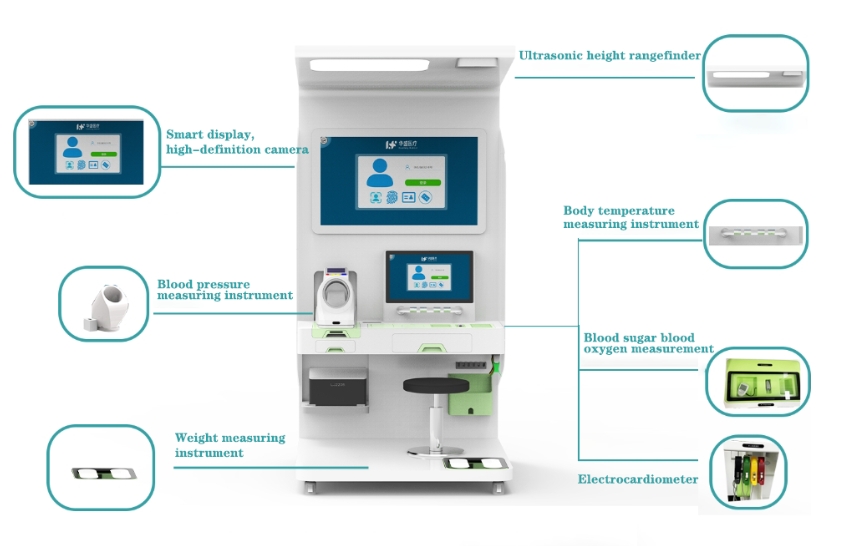
The core of the intelligent Health Check-up Kiosk lies in the collaborative operation of its multi-module sensors. Taking basic vital sign detection as an example:
Bioelectric Signal Capture:
For ECG measurement, the device uses electrode pads to capture the body's faint bioelectric signals. These signals are amplified and processed into intuitive ECG waveforms, providing doctors with diagnostic references.
For blood pressure measurement, the device employs the oscillometric method. A pressure sensor detects real-time arterial pulse-induced pressure changes, and an algorithm automatically calculates systolic and diastolic blood pressure.
Bioelectrical Impedance Analysis:
Body fat detection utilizes bioelectrical impedance analysis (BIA). The device sends a safe, low-level electrical current through electrodes and calculates body fat percentage, muscle mass, and other body composition metrics based on differences in conductivity among tissues (e.g., fat, muscle, water).
Optical Detection Technology:
For blood oxygen measurement, the device leverages the varying absorption rates of red and infrared light by hemoglobin. An optical sensor captures changes in transmitted light intensity to accurately calculate blood oxygen saturation (SpO₂).
2. IoT and 5G Technology: Building High-Speed Data Transmission Channels
For detection data to be quickly and stably transmitted to the cloud for analysis, the support of IoT and 5G technologies is indispensable:
Edge Computing Preprocessing:
The built-in chip in the Health Check-up Kiosk performs preliminary cleaning of raw data, eliminating noise interference and compressing data volume to enhance transmission efficiency.
Multi-Protocol Communication Support:
The device supports various communication protocols, including Wi-Fi, Bluetooth, and 4G/5G, ensuring seamless data upload in seconds across different scenarios such as communities and households.
Real-world tests show that under a 5G network, transmitting 10MB of detection data takes only 0.3 seconds.
Data Encryption Protection:
To ensure the security of personal health data during transmission and storage, the device employs AES-256 encryption, complying with medical data privacy protection standards.
3. AI Algorithm Empowerment: Transforming Data into Insights
From Raw Data to Actionable Insights:
The collected data must be converted into meaningful health information, where AI algorithms play a pivotal role.
Machine Learning Models:
Trained on millions of clinical datasets, machine learning models can identify abnormal ECG waveforms, retinal vascular lesions, and other critical markers.
For example, the AI-powered retinal analysis model achieves a 97% accuracy rate in screening for diabetic retinopathy.
Dynamic Health Assessment:
The Health Check-up Kiosk integrates user-specific data (age, gender, medical history, etc.) to build a personalized health model.
When detecting abnormal blood pressure trends over time, the system automatically analyzes patterns and triggers multi-level health alerts.
Intelligent Decision Support:
Based on assessment results, the device generates tailored intervention plans, including dietary and exercise recommendations.
Data from one enterprise showed that after adopting AI-recommended meal plans, employees' average body fat percentage decreased by 3.2%.
This AI-driven approach not only enhances diagnostic precision but also enables proactive and personalized health management.
4. Software System Integration: Enabling End-to-End Health Management
The seamless collaboration between hardware and algorithms relies on the integration of intelligent software systems:
User-Friendly Interface:
Featuring a touchscreen display and voice-guided navigation, the device offers intuitive operation with visualized workflows, ensuring ease of use even for elderly users.
Comprehensive Health Records:
Automatically generates dynamic health profiles, including historical test data and warning records, with multi-device synchronization for real-time access to personal health status.
Remote Healthcare Connectivity:
Integrates with hospital HIS (Hospital Information Systems), enabling direct transmission of test data to physicians' workstations.
Supports telemedicine consultations and e-prescription services, optimizing the allocation of medical resources.
From Micro to Macro:
Starting with sensor-level signal acquisition and culminating in the construction of a holistic health ecosystem, the smart health all-in-one machine achieves full-chain health management—detection → transmission → analysis → intervention.
With ongoing advancements in AIoT (AI + IoT) technology, future iterations will possess even stronger disease prediction capabilities, truly becoming a "digital health guardian" for every individual.
This integration of cutting-edge technologies not only enhances efficiency but also democratizes personalized, proactive healthcare for all.
Categories
Latest News
- Integrated Health Machine: Reshaping the Smart Service Ecosystem of TCM Wellness Centers
- Integrated Health Management Kiosk: The Core Engine for Pharmacy Transformation into Smart Health Services
- Blood Bank Self-Check-In Healthcare Medical Kiosks: Innovative Practices and Core Values of Basic Screening
- A New Line of Defense for Campus Health: The Value and Advantages of the Integrated Health Kiosk
- AI Evaluation Self Service Tele-Health & Tele-Medicine Health Kiosk: An Innovative Engine for Insurance Company Marketing and Member Services
Contact Us
Company: Shenzhen Huasheng Medical Technology Co., Ltd.Contact: Miss Wang
Tel: +86 159 8911 4474
WhatsApp 1: +86 177 2472 6642
WhatsApp 2: +86 198 6570 7933
Email: wincywang@hsyil.com
Address: Room 406, Danfeng Technology Building, Building 2, Chaguang Village Industrial Park, Shuguang Community, Xili Street, Nanshan District, Shenzhen
 Tel:
Tel: